Why did my share of building expenses go up in a year the building was half-empty?
Because many leases let the landlord gross up the costs that move with occupancy — trash removal, common-area cleaning, utilities in shared spaces — to what they would have been in a full building, and only then divide that total among the tenants who are actually there. That’s why a reimbursement bill can climb in a year occupancy dropped.
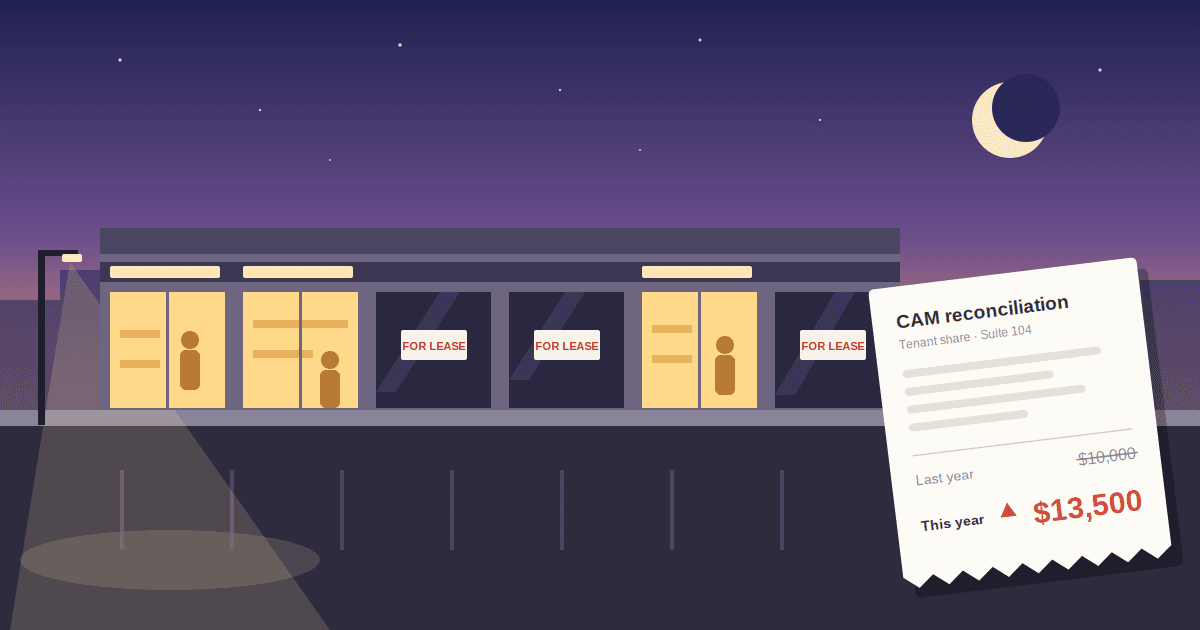
Some of the costs a landlord passes through to tenants don’t shrink much when a building loses tenants. A half-empty building still needs its lobby lit and its dumpster emptied. The expense provisions of most leases are written around a fully occupied building, so the gross-up adjusts the occupancy-driven costs to that assumption before anyone’s share is applied. It’s also why two tenants with the same square footage in two different buildings can see very different increases, depending on how full each building was.
If you’re the one preparing the reconciliation, this adjustment is also one of the easiest places to make a costly mistake — in either direction.
Which costs this actually applies to
Not every operating expense behaves the same way when occupancy changes. Roughly:
- Costs that scale with occupancy — janitorial service billed per occupied square foot, common-area electricity, water for irrigation tied to usage, trash volume. These genuinely cost less when fewer tenants are generating less activity.
- Costs that don’t scale with occupancy — landscaping contracts, security patrols, a fixed management fee, general repairs. The landlord pays close to the same amount whether the building is 60% or 100% leased.
The adjustment only makes sense for the first group. If a lease’s definition of the adjustment sweeps in the second group too — fixed costs that never dropped in the first place — that’s not a technicality. That’s tenants being charged for a vacancy the landlord has no real cost from.
A worked example: a strip center at 60%
A 50,000 sq ft strip center is only 60% leased this year: 30,000 sq ft occupied, 20,000 sq ft vacant. The lease allows the landlord to gross up occupancy-driven costs to 95% occupancy before billing tenants.
| Cost category | Actual cost at 60% occupancy | Behavior |
|---|---|---|
| Janitorial, common-area utilities, trash | $60,000 | Scales with occupancy — eligible for the adjustment |
| Landscaping, security, fixed management fee | $40,000 | Fixed — not eligible for the adjustment |
| Step 1. Occupancy-driven pool, $60,000 ÷ 60% × 95% | $95,000 |
|---|---|
| Step 2. Fixed pool, added back unadjusted | $40,000 |
| Total pool for reimbursement | $135,000 |
Step 3 is one tenant’s share. A tenant leasing 5,000 sq ft — 10% of the building — pays 10% of the pool, and the pool depends entirely on which costs were grossed up:
| Scenario | Pool | Tenant’s bill (10% share) |
|---|---|---|
| No adjustment, actual costs only | $60,000 + $40,000 = $100,000 | $10,000 |
| Correct: occupancy-driven costs only | $95,000 + $40,000 = $135,000 | $13,500 |
| Mistake: everything grossed up, fixed costs included | $95,000 + $63,333 = $158,333 | $15,833 |
The middle row is the correct number under most leases. The bottom row is the mistake: $40,000 of fixed costs grossed up as if they had dropped with occupancy, when they never did.
| Billed with fixed costs grossed up | $15,833 |
|---|---|
| Billed under the lease | $13,500 |
| Overcharge, repeated for every tenant | $2,333 |
What to check in your lease
- Does the lease allow this adjustment at all? Older or shorter-form leases sometimes don’t include the clause — if it’s silent, don’t apply it.
- What occupancy level does the lease name? Common language is “not less than 95%,” but some leases name a different number, or reference a rolling average instead of year-end occupancy.
- Which costs are explicitly eligible? Look for wording like “those Operating Expenses that vary with occupancy” — that phrase is doing the work of separating the two groups above.
- Is there a cap on the adjustment itself, separate from any cap on expense growth? Some leases limit how far above actual occupancy the pool can be adjusted.
- Does the base year use the same adjustment? If the lease has a base year stop, check whether the base figure was calculated on the same occupancy assumption — two different assumptions in one reconciliation are a common source of disputes.
- If you inherited the property, did the prior manager apply the adjustment consistently year over year? A sudden change in method is the first thing a tenant’s auditor will flag.
Where the gross-up sits against the cap in the order of operations changes the ceiling too — and the cap sentence itself is its own trap: cumulative vs. compounding CAM cap, in dollars
Why this matters more than it looks like it should
This single adjustment is one of the line items tenants push back on most, because it’s the one part of a reconciliation that doesn’t map to a number they can see on an invoice. There’s no vendor bill that says “$95,000.” It’s a calculation, and calculations are exactly where trust is won or lost.
Getting the base right, in writing, before the statement goes out, is cheaper than defending it after.
Send the lease you’re least sure about
One lease comes back as a written reimbursement profile: exactly which costs are eligible for the gross-up, at what occupancy level, and why — each answer quoted to the page it came from.
Send the leaseNo charge, 48 hours, no call required. Redact names and rent if you’d rather — the operating expense and gross-up sections are the ones that matter.
Sources
Cost categories follow BOMA International’s operating expense definitions and IREM (Institute of Real Estate Management) commercial property management training materials; lease language is reviewed directly, not through vendor summaries. The strip center and its figures are a constructed example, not a reconciled property.